ViKing LawViKing Law2026-09-03T09:20:03Zhttps://www.viking-law.com/feed/atom/WordPress/wp-content/uploads/sites/1303918/2023/03/cropped-VL-site-icon-32x32.pngOn Behalf of ViKing Law<![CDATA[ViKing Law Secures $7.6 Million Settlement in Fatal Pennsylvania Trucking Accident]]>https://www.viking-law.com/?p=468592026-09-03T04:08:29Z2026-09-03T04:08:29ZA Chain-Reaction Trucking Accident With Devastating Consequences
Truck crashes can have consequences far beyond the initial collision. When a tractor-trailer jackknifes on an interstate, particularly during severe winter weather, it can create an extraordinarily dangerous situation for everyone traveling behind it.
In this case, the initial jackknife created a traffic obstruction that resulted in a chain reaction involving additional tractor-trailers. The subsequent impacts subjected our client to tremendous forces and caused catastrophic injuries.
What began as a winter-weather trucking incident ultimately became a fatal crash that forever changed the lives of our client and the client’s family.
Investigating Every Link in the Chain
Complex trucking accidents require a thorough investigation. Liability may involve multiple drivers, trucking companies, vehicle owners, maintenance providers, insurers, and other potentially responsible parties.
[nap_names id="FIRM-NAME-1"] pursued a comprehensive investigation into the circumstances surrounding this crash, including the events leading up to the initial tractor-trailer jackknife and the subsequent chain-reaction collisions.
In trucking cases, critical evidence can disappear quickly. Important evidence may include electronic control module data, electronic logging data, driver records, vehicle inspection and maintenance records, GPS information, photographs, video footage, trucking-company policies, and evidence concerning the drivers and vehicles involved in the collision.
Understanding how the crash unfolded – and determining who may be legally responsible – is essential in pursuing justice for a seriously injured victim and the victim’s family.
Holding Responsible Parties Accountable
When a commercial truck crash results in catastrophic injury or death, the investigation must go beyond simply identifying the vehicle that made the initial impact.
The circumstances surrounding the entire sequence of events must be examined.
Was the tractor-trailer traveling at an appropriate speed for the weather and roadway conditions? Were appropriate safety precautions taken? Were the driver and trucking company complying with applicable federal and state regulations? Were the vehicles properly maintained? Could the collision and resulting pileup have been prevented?
These are among the questions that can be critical in a serious trucking accident investigation.
$7.6 Million Settlement
After aggressively pursuing the claim and investigating the circumstances surrounding this devastating accident, [nap_names id="FIRM-NAME-1"] secured a $7.6 million settlement for our client’s case.
While no amount of money can undo the loss of a loved one, pursuing a substantial recovery can provide important financial security for surviving family members and hold responsible parties accountable for the consequences of their actions.
At [nap_names id="FIRM-NAME-1"], we understand that trucking accident cases are about more than the vehicles involved or the mechanics of a collision. They are about people, families, and lives that can be permanently changed in a matter of seconds.
Our firm is committed to conducting the thorough investigations necessary to uncover what happened and pursuing every available source of compensation for our clients and their families.
Injured in a Pennsylvania Trucking Accident?
If you or a loved one has been seriously injured – or a family member has been killed – in a Pennsylvania trucking accident, having experienced legal representation can be critical. Trucking cases often involve complex evidence, multiple potentially responsible parties, and substantial insurance coverage.
[nap_names id="FIRM-NAME-1"] represents victims and families in serious trucking accidents throughout Pennsylvania.
Contact [nap_names id="FIRM-NAME-1"] to discuss your case and learn about your legal options.]]>On Behalf of ViKing Law<![CDATA[ViKing Law Secures $2 Million Settlement for Philadelphia Trip-and-Fall Victim]]>https://www.viking-law.com/?p=468572026-09-03T03:58:30Z2026-09-03T03:58:30ZA Serious Fall With Life-Changing Consequences
For an older adult, a fall can have devastating consequences. What may appear to be a simple trip can result in fractures, surgery, lengthy rehabilitation, and significant limitations on a person’s ability to live independently.
In this case, our client’s injuries required extensive medical treatment and a long road to recovery. The physical consequences of the fall were compounded by the challenges associated with undergoing additional surgery involving her knee hardware.
[nap_names id="FIRM-NAME-1"] thoroughly investigated the circumstances surrounding the incident, developed the evidence necessary to establish liability, and aggressively pursued full compensation for our client’s injuries and losses.
Fighting for Full and Fair Compensation
Premises liability cases can be challenging. Property and business owners may dispute responsibility for an accident or argue that an injured person was responsible for her own fall. Establishing liability requires a careful examination of the conditions that caused the incident, the property owner or establishment’s responsibilities, and the evidence surrounding the accident.
[nap_names id="FIRM-NAME-1"] understands the importance of conducting a comprehensive investigation from the beginning of a premises liability case. This can include examining the location where the incident occurred, identifying dangerous or defective conditions, preserving evidence, reviewing photographs and surveillance footage, interviewing witnesses, and obtaining the medical evidence necessary to document the full extent of a client’s injuries.
Our goal is not simply to establish that an accident occurred. Our goal is to make sure our clients receive the compensation they deserve for the full impact of their injuries.
$2 Million Settlement
After aggressively pursuing our client’s claim, [nap_names id="FIRM-NAME-1"] obtained a $2 million settlement on her behalf.
This recovery reflects the seriousness of our client’s injuries and the significant impact the fall had on her life.
At [nap_names id="FIRM-NAME-1"], we believe that injured people deserve experienced advocates who will take the time to understand what happened, investigate the evidence, and fight for the compensation they are entitled to receive.
If you or a loved one has been injured in a trip-and-fall or other premises liability accident in Pennsylvania, contact [nap_names id="FIRM-NAME-1"] to discuss your case.
If you'd like, I can also turn this into a more aggressive, SEO-focused version designed to rank for “Philadelphia trip and fall lawyer” and “Philadelphia premises liability lawyer,” while making the $2 million result the centerpiece.]]>On Behalf of ViKing Law<![CDATA[Do You Have a Defamation Case in Pennsylvania? A 7-Step Guide]]>https://www.viking-law.com/?p=468522026-08-14T17:59:13Z2026-08-14T17:59:13ZIn today’s digital age, a single false post, review, or statement can damage your personal reputation or devastate a business you built from the ground up. But when someone says or writes something harmful about you, does it legally qualify as defamation?
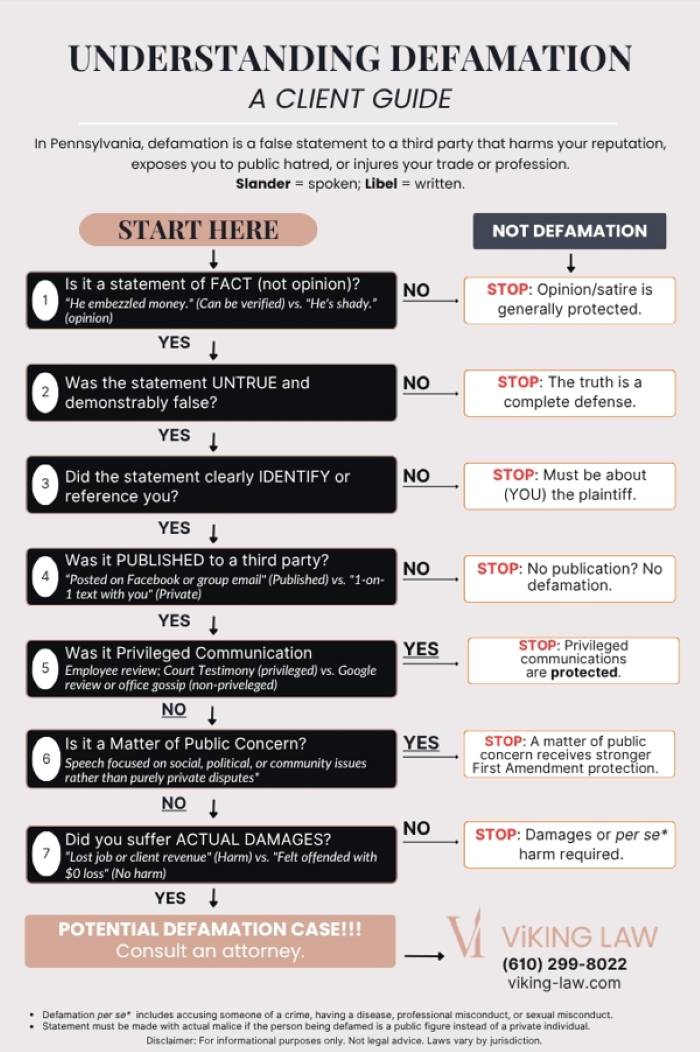
In Pennsylvania, defamation is defined as a false statement made to a third party that harms your reputation, exposes you to public hatred, or injures your trade or profession. Before taking legal action, it helps to understand the distinction between the two primary types of defamation:
Slander: Defamatory statements that are spoken
Libel: Defamatory statements that are written or published
To help you evaluate whether a situation meets the legal threshold for a claim, use the decision flowchart below alongside our step-by-step breakdown.
Important Exceptions and Nuances
Defamation Per SeIn Pennsylvania, certain false statements are considered so naturally harmful that damage to your reputation is presumed by law without requiring proof of direct financial loss. This is known as defamation per se. Categories typically include false accusations of:
Committing a crime
Having a loathsome, contagious disease
Professional misconduct or incompetence in your trade
Serious sexual misconduct
Public Figures vs. Private Individuals
If the person being defamed is a public figure or official, the legal bar is significantly higher. Public figures must prove actual malice, meaning the person making the statement knew it was false or acted with reckless disregard for whether it was true or false.
Do You Have a Potential Defamation Case?
If you walked through the flowchart and answered YES to all seven steps, or if you believe you are facing a case of defamation per se, it is time to seek professional legal guidance. Contact Viking Law today to schedule a free consultation and evaluate your legal options. Disclaimer: For informational purposes only. Not legal advice. Laws vary by jurisdiction. ]]>On Behalf of ViKing Law<![CDATA[Viking Law Helps Dog Bite Victims in Doylestown and Across Pennsylvania]]>https://www.viking-law.com/?p=468262025-11-25T09:25:07Z2025-11-24T09:02:51Z
Who Is Liable After a Dog Bite in Pennsylvania?
Under Pennsylvania dog bite law, the dog’s owner or keeper is strictly liable for your medical bills if their dog bites you. That’s true even if the dog never showed aggression before.
But to recover money for pain and suffering, lost income, scarring, or other damages, you usually need to prove negligence or that the dog had dangerous propensities and the owner knew or should have known.
Start with the location of where the attack occurred and check the local municipal laws regarding dogs. Some municipalities require dogs to be leashed at all times while others only require it in certain circumstances.
For example, in Newtown Borough, PA, all dogs must be on a leash when not on the owner’s property. There are limited exceptions for dog parks with fences. Dogs are considered personal property, and therefore owners are responsible for damages caused by their dog.
The dog’s history and propensity for attacks is also relevant. If the dog has ever attacked anyone before and it was not reported but known to have happened, the owners are liable for the attack.
“Any cost to the victim for medical treatment resulting from an attacking or biting dog must be paid fully by the owner or keeper of the dog.” (3 P.S. § 459-502(b)(1))
Proving Liability: Three Legal Paths
1. Strict Liability for Medical Bills
If you suffered a bite, the owner must pay your medical costs. No need to prove the dog was dangerous.
2. Negligence
If the dog was unrestrained, unsupervised, or allowed to roam, the owner may be found negligent. You must prove:
The owner owed a duty of care
They breached that duty
Their negligence caused your injuries
Example: A dog escapes a yard with a broken fence and bites someone. The owner failed to fix the fence — that’s likely negligence.
3. Negligence Per Se
If the owner violated the Pennsylvania Dog Law, for example, letting a dog run loose or failing to muzzle a dangerous dog — that violation can automatically establish liability under the doctrine of negligence per se.
Violating section 502-A (harboring a dangerous dog) can support this claim, especially if the bite resulted in:
Broken bones
Disfiguring lacerations
Cosmetic surgery
These are considered “severe injuries” under the statute.
Does Pennsylvania Follow the “One Free Bite” Rule?
Not anymore. Courts in Pennsylvania have made it clear:
Even a dog’s first bite can lead to legal liability especially if the injury is severe.
The 1996 amendments to the Pennsylvania Dog Law eliminated the outdated idea that a dog must bite once before the owner can be held liable.
What Counts as a “Dangerous Dog” in PA?
A dog may be legally classified as dangerous if it:
Bites or attacks without provocation
Inflicts severe injury (broken bones, scarring, etc.)
Has a history of aggression toward people or animals
Dangerous dogs must be properly confined and muzzled when off-property. Violations of these rules often lead to criminal charges and civil liability.
Can You Sue a Landlord for a Dog Bite?
Usually, landlords are not responsible unless:
They knew the dog was dangerous
They had control over the premises and the ability to remove the dog
In most cases, the dog owner or keeper is the liable party, not the landlord.
Should You Report a Dog Bite in Pennsylvania?
Yes. Always. Reporting the bite helps:
Document the attack for your legal claim
Trigger an animal control investigation
Potentially prevent future attacks on others
Call animal control or your local police department right away. In Doylestown, for example, get the owner's information and vaccination records. Contact the Bucks County Health Department or the police to report the incident and start an investigation.
Bucks County Health Department Phone: 215-345-3336
What Compensation Can Dog Bite Victims Recover?
If your injury involved more than basic medical costs, and the owner was negligent or violated the Dog Law, you may be able to recover for:
Medical expenses (past & future)
Lost wages
Pain and suffering
Permanent scarring or disfigurement
Emotional trauma and anxiety
Loss of earning potential
Viking Law Can Help You Recover After a Dog Bite Injury
Dog bite injuries are serious and so is your right to compensation. At Viking Law, we fight to hold negligent dog owners accountable and help our clients rebuild after a traumatic injury.
Our attorneys understand Pennsylvania’s dog bite laws, insurance claim tactics, and how to build a strong case that gets results.
Don’t let one bite define your future. Let’s talk.
📞 Call Viking Law today for a free consultation.
Or use our online form to get started now.
For more information on Dog Bites in PA, visit or contact the Bureau of Dog Law Enforcement by calling 717-787-3062 or emailing them at ra-agdoglaw@pa.gov.]]>On Behalf of ViKing Law<![CDATA[Viking Law Wins $1.76 Million Jury Verdict for Survivor]]>https://www.viking-law.com/?p=468212025-10-31T12:18:19Z2025-10-31T11:37:00ZOn Behalf of ViKing Law<![CDATA[Newtown morning traffic accidents: What to do if you’re hit]]>https://www.viking-law.com/?p=467962025-07-16T11:12:47Z2025-07-16T11:12:47ZIf you've spent any time driving through Newtown during the morning rush, you've seen how quickly traffic piles up on the Bypass, Route 332 and I-295. Cars stop short, drivers weave through tight lanes, and before you know it, one mistake sets off a chain reaction. These pileups happen fast, whether someone looks down at their phone or slams the brakes too late. Congestion turns small errors into multicar crashes, especially when people are in a hurry to get to work or school.
What you need to do right after a morning crash
The first thing you do is protect yourself. Get your vehicle to a safe spot if you can and call 911 as soon as possible. Don't try to figure out who caused what at the scene – that comes later. For now, exchange insurance and contact information with the other drivers and start documenting everything you can: photos of the crash, the vehicles involved and the road conditions around you. In multicar accidents, evidence matters because multiple drivers may share responsibility.
Fault in Pennsylvania pileups is not always clear-cut
In Pennsylvania, determining fault in a chain-reaction crash gets complicated fast. You've probably heard that we follow a modified comparative negligence rule, meaning the court looks at everyone's actions and assigns a percentage of fault. If your share of the blame stays below 51%, you can still recover compensation from the other driver – or drivers – who caused the crash. Police reports, witness statements and the physical damage to each vehicle help paint a clearer picture of what really happened.
Filing your claim without adding to your stress
After a crash, your personal injury protection (PIP) will cover your medical bills, no matter who was at fault – that's part of Pennsylvania's no-fault insurance system. But when your injuries or property damage go beyond that, the next step is filing a claim against the at-fault driver's insurance. In multicar crashes, that might mean dealing with several insurers at once. If you feel overwhelmed, a local attorney can help you sort through the confusion and fight for what you are owed.
Helping you get back on the road after a crash
You didn't plan for your morning commute to end in a pileup, but now that it has, you need to protect yourself and your next steps. Take care of your health first, get your claim moving and don't hesitate to ask for help when the legal process feels overwhelming. You've got enough on your plate, so let someone who knows Pennsylvania's accident laws help you figure out what comes next.]]>On Behalf of ViKing Law<![CDATA[Construction injuries and investigations: Tips for victims]]>https://www.viking-law.com/?p=467892025-05-02T16:17:01Z2025-05-02T16:17:01ZWhat should I expect from investigators?
An investigation by the Occupational Safety and Health Administration (OSHA) or supervisors will likely include an examination of the scene, the gathering of evidence, and interviews of witnesses. Official investigators will use this information to piece together the events leading to the accident.
Injured workers should anticipate the following:
Detailed examination: Investigators will scrutinize the accident site, equipment, and safety protocols to identify any violations or negligence.
Interviews: Expect interviews with witnesses, supervisors, and other relevant parties to gather firsthand accounts of the incident.
Documentation review: Investigators will also review safety records, training logs, and maintenance reports to assess compliance with regulations.
Injured workers are wise to gather and organize evidence to support their claims. This can include photographs of the accident scene and visible injuries as well as copies of all related medical records. Having a copy of witness statements is also helpful.
Should I prepare for litigation?
This depends on the details of the case. If you are a worker injured while on-the-job, litigation is unlikely. This is because compensation should be available through a workers’ compensation claim. It is important to note that legal counsel can help to better ensure injured workers receive fair compensation as denials or low compensation offers are a common issue.
There are two scenarios where preparation for litigation is wise. For workers, there are situations when a third-party liability claim may offer additional compensation. Another scenario involves victims who are not construction workers. This could include someone who was injured while walking past the site at the time of the accident. In these situations, it is helpful to take steps to prepare. This can include consulting with legal counsel with experience with construction accidents as well as keeping the documentation that you prepared for the investigation discussed above available for use during litigation.
Construction accidents can lead to serious injuries for workers and those near the sites. Victims are wise to take the matter seriously and take steps to protect their rights. A few steps in the right direction can go a long way to better ensuring fair compensation to cover the costs resulting from the accident.]]>by ViKing Law<![CDATA[Understanding Key Auto Insurance Definitions: A Guide for Policyholders]]>https://www.viking-law.com/?p=467212024-09-26T15:28:39Z2024-08-19T16:30:26Z1. Premium
The premium is the amount of money you pay to the insurance company for your auto insurance policy. This payment can be made monthly, quarterly, semi-annually, or annually, depending on the terms of your policy. The premium amount is influenced by various factors, including your driving record, the type of car you drive, your age, and where you live.
2. Deductible
A deductible is the amount you agree to pay out of pocket before your insurance company covers the remaining costs of a claim. For example, if you have a $500 deductible and are involved in an accident that results in $2,000 in damages, you will pay the first $500, and your insurance will cover the remaining $1,500. Choosing a higher deductible typically lowers your premium, but it also increases your financial responsibility in the event of a claim.
3. Liability Coverage
Liability coverage is a mandatory component of auto insurance in most states. It protects you financially if you are at fault in an accident that causes bodily injury or property damage to others. Liability coverage is typically split into two parts:
Bodily Injury Liability (BIL): Covers medical expenses, lost wages, and pain and suffering of the other party if you are responsible for the accident. In Pennsylvania, you must provide at least $15,000 per person, and $30,000 per accident in coverage. In New Jersey, those state minimums are now $25,000 - $50,000.
Property Damage Liability (PDL): Covers the cost of repairing or replacing the other party’s vehicle or property damaged in the accident.
4. Collision Coverage
Collision coverage pays for the repair or replacement of your vehicle if it is damaged in an accident, regardless of who is at fault. This coverage is particularly important if you have a newer or more expensive vehicle, as it helps protect your investment. However, collision coverage is usually optional and comes with a deductible.
5. Comprehensive Coverage
Comprehensive coverage protects your vehicle from non-collision-related damages, such as those caused by theft, vandalism, natural disasters, or falling objects. Like collision coverage, comprehensive coverage is optional and is subject to a deductible. This coverage is essential for those who want protection from a wider range of risks beyond just accidents. This does NOT give you Full Tort coverage, which is completely separate, as explained in the tort blog.
Uninsured/Underinsured Motorist Coverage is designed to protect you if you are involved in an accident with a driver who either doesn’t have insurance (uninsured) or doesn’t have enough insurance to cover the full extent of the damages (underinsured). This coverage can pay for medical expenses, lost wages, and other damages that you would otherwise have to cover out of pocket if the at-fault driver lacks adequate insurance. This is not mandatory and can be waived, but ViKing Law does not recommend waiving this coverage. If it is waived, you will be left with nothing following a serious accident if you happen to be struck by an uninsured or underinsured driver. These benefits can also be “stacked” meaning multiplied by how ever many vehicles you own. Example: If you have $15,000/$30,000 UM/UIM coverage, stacked, with three vehicles on the policy, you actually have up to $45,000/$90,000 in UM/UIM coverage total.
7. Personal Injury Protection (PIP)
Personal Injury Protection, also known as PIP or “no-fault” insurance, covers medical expenses, lost wages, and other related costs for you and your passengers, regardless of who is at fault in the accident. PIP is mandatory in Pennsylvania and New Jersey. It can also cover additional expenses like rehabilitation and funeral costs, making it a comprehensive protection for injury-related expenses. Pennsylvania’s mandatory minimum PIP coverage that must be provided by all insurance carriers is $5,000.
8. Gap Insurance
Gap insurance covers the difference between the actual cash value of your vehicle and the amount you owe on your car loan or lease if your car is totaled in an accident. This is particularly useful if you owe more on your vehicle than it’s worth, which can happen with new cars that depreciate quickly. Without gap insurance, you could be left paying off a loan for a vehicle you no longer own.
9. SR-22
An SR-22 is not an insurance policy, but a certificate that your insurance company files with your state’s Department of Motor Vehicles (DMV) to prove that you have the minimum required liability insurance. It’s typically required for drivers who have been convicted of certain offenses, such as DUI, or who have had their license suspended. The SR-22 shows that you are meeting the state’s insurance requirements, but it also usually comes with higher premiums.
10. Actual Cash Value (ACV)
Actual Cash Value is the amount your insurance company will pay to replace your car if it’s totaled, factoring in depreciation. This is different from the replacement cost, which would cover the cost of buying a new car of the same make and model. Understanding ACV is important because it means that as your car ages, the payout from your insurance in the event of a total loss will decrease.
Confused about your coverage and what rights you have after an accident? Call Viking Law.]]>by ViKing Law<![CDATA[Full Tort vs. Limited Tort Insurance: Understanding the Difference in Pennsylvania]]>https://www.viking-law.com/?p=467192024-09-26T15:29:03Z2024-08-19T16:24:50ZWhat is Tort Insurance?
A “tort” is a wrongful act that causes harm to someone, and under tort law, the person who is harmed can seek compensation from the person responsible for the harm. In auto insurance, tort options determine your right to sue for damages after a car accident.
Full Tort Insurance
Full Tort insurance gives you the unrestricted right to sue the at-fault driver for both economic and non-economic damages after an accident. This includes:
Economic Damages: These are quantifiable financial losses, such as medical bills, lost wages, and property damage.
Non-Economic Damages: These refer to compensation for pain and suffering, emotional distress, and loss of life’s enjoyment—damages that are more subjective and harder to quantify.
With full tort coverage, you maintain the right to pursue compensation for these non-economic damages, regardless of the severity of your injuries. This can be particularly important if you suffer long-term effects, such as chronic pain or a reduced quality of life, that go beyond the costs of medical treatment.
Limited Tort Insurance
Limited Tort insurance, on the other hand, restricts your ability to sue for non-economic damages. While you can still seek compensation for economic losses like medical expenses and lost income, your ability to recover damages for pain and suffering is generally limited. Most attorneys that find out you have limited tort coverage will not even take your case unless your injuries involved serious, like altering injuries to the point you are no longer able to work.
However, there are exceptions to this limitation. You may be able to sue for non-economic damages under limited tort coverage if your injuries meet the legal definition of “serious injury,” which can include:
Death
Significant disfigurement
Dismemberment
Permanent loss of a bodily function
Permanent and serious disfigurement
These exceptions are meant to provide recourse in cases where the injury has a profound impact on your life, but they set a high bar that many injuries do not meet.
Cost Differences
Limited tort insurance typically comes with lower premiums compared to full tort coverage. The trade-off, however, is the limitation on your right, and your resident family members rights, to sue for non-economic damages, which could be significant depending on the nature of the accident and your injuries.
While full tort insurance may be more expensive upfront, it provides broader protection and greater flexibility in pursuing compensation if you are injured in an accident. This can be especially valuable if you suffer injuries that, while not meeting the threshold for a “serious injury,” still have a significant impact on your life.
Viking Law always recommends obtaining full tort insurance no matter what.]]>by ViKing Law<![CDATA[Understanding Defamation Law in Pennsylvania: A Legal Overview]]>https://www.viking-law.com/?p=467172024-09-26T15:30:15Z2024-08-19T16:07:18Zlibel, which refers to written or published defamatory statements, and slander, which involves spoken defamatory remarks. Understanding the intricacies of defamation law in Pennsylvania is crucial for anyone involved in communication, whether in media, business, or personal interactions.
What Constitutes Defamation in Pennsylvania?
To successfully bring a defamation claim in Pennsylvania, the plaintiff must prove several key elements:
Defamatory Statement: The statement in question must be defamatory, meaning it would harm the reputation of the person or entity in the eyes of the community or lead others to avoid them.
Publication: The defamatory statement must be communicated to at least one person other than the subject of the statement. In legal terms, this is referred to as “publication,” and it applies to both libel and slander. This includes posting a comment online
Falsity: The statement must be false. Truth is an absolute defense to defamation, so if the statement is true, it cannot be deemed defamatory, no matter how damaging it may be.
Fault: The plaintiff must prove that the defendant was at fault when making the statement. In Pennsylvania, the level of fault required depends on the plaintiff’s status. Public figures or officials must show that the defendant acted with “actual malice,” meaning they knew the statement was false or acted with reckless disregard for the truth. Private individuals, on the other hand, need only prove that the defendant was negligent in making the false statement.
Harm: The plaintiff must demonstrate that the defamatory statement caused harm, such as damage to their reputation, emotional distress, or financial loss. However, in some cases, such as those involving false accusations of a crime, harm may be presumed.
Pennsylvania courts have established some unique principles in defamation law, including the recognition of “per se” defamation. In cases involving defamation per se, certain statements are considered so inherently harmful that the plaintiff does not need to prove actual harm. These include false accusations of criminal activity, incompetence in one’s profession, or having a loathsome disease.
Key Defenses to Defamation in Pennsylvania
Defendants in defamation cases have several potential defenses available to them:
Truth: As mentioned, truth is a complete defense to a defamation claim. If the statement is true, it cannot be defamatory.
Opinion: Statements of opinion are generally not actionable as defamation. However, this defense only applies if the statement cannot reasonably be interpreted as stating actual facts.
Privilege: Certain statements are protected by privilege, meaning they cannot be the basis for a defamation lawsuit. For example, statements made during judicial proceedings or in government meetings are typically privileged.
Another important aspect is the “fair report privilege,” which protects accurate reports of official proceedings or public records, even if the content of those proceedings or records is defamatory.
Consent: If the plaintiff consented to the publication of the statement, they cannot later claim defamation.
In Pennsylvania, the statute of limitations for defamation claims is one year from the date the defamatory statement was made or published. This means that a lawsuit must be filed within this time frame, or the claim will be barred.
If you or someone you know has been defamed, or are being sued for defamation, contact Viking Law for assistance.]]>